
- Insights
Keep the Doors Open: Focus on Your People.TitanOps Keeps Watch.
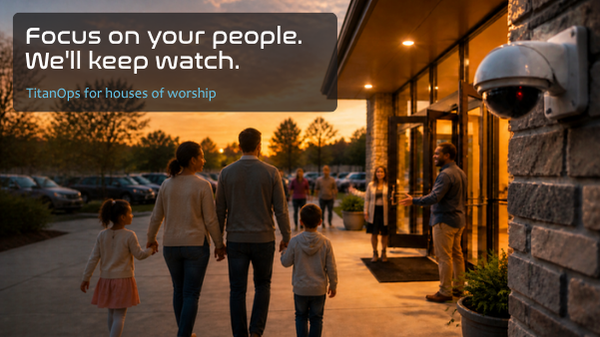
A house of worship is a place to gather, to grow and to belong. It is where a family finds community, a newcomer finds a seat saved for them, and someone going through a hard season finds people who show up. It is a place to celebrate and to mourn, to learn and to serve, together.
Walk in on a busy day and you feel it. Greeters know your name, kids run down the hall as if they own the place, a youth group sets up chairs, and the food pantry team loads boxes for neighbors. Programs fill the week, from preschool to seniors' groups, and the doors stay open to anyone who needs them. That feeling is the whole point, and it is what every safety decision has to protect.
Then the lot empties, the lights go off, and the same building sits quiet. Houses of worship of every faith carry the same tension: a place built to welcome everyone still has to be watched. The FBI recorded 2,408 religion-based hate crime incidents in 2025, and congregations of every tradition were among those affected.
The people at the door are volunteers
The best security in a house of worship is still a person who notices. Greeters, ushers and safety team members know the regulars, sense when someone seems out of place, and respond with care instead of force. CISA's guidance puts it plainly: security has to work while the place stays open and welcoming.
Most of those people are there to serve, not to be security professionals. They give their time because they care about the people in the room. They may be on duty a few times a month, trained when they join and refreshed now and then. That is a lot to ask of anyone's memory.
Questions worth asking
- Who is watching the lot during the gathering? When the safety team is inside, the parking lot, the side doors and the back of the building are on camera and unwatched.
- How timely is your medical response? A congregation spans every age and ability. Someone slips on the steps, a member sits down and doesn't get up, a visitor sits alone in the lot in distress. Would the team inside know?
- If something happens when no one is there, how will you know? Vandalism, arson and theft tend to come after hours, and footage only tells you about it the next morning.
- Where does the knowledge live? The plan sits in a binder, or in one person's head. Volunteers who serve once or twice a month can't be expected to remember every step, and the person on duty that week has to recall it under stress.
- Who should be where, and when? A preschool, a food pantry, classes, weddings and funerals each change the answer through the week.
What TitanOps adds, in three parts
- Works with the systems you already have. TitanOps runs on the cameras you already own, from any manufacturer. No rip and replace, and no new hardware to learn before it starts helping.
- Alerts on what you want, in real time. You decide what matters, and rules follow your calendar: any person at the side door during a gathering, the children's wing after program hours, a vehicle dwelling in the fire lane. TitanOps detects behavior, not identities. Members and guests are never suspects.
- Response assistance on every alert. TitanOps brings up your own safety plan and recommends next steps in order, so a volunteer on their second shift follows the same plan as your most experienced leader. Nobody has to remember the binder. Incident reports are pre-filled with where, when and what happened.
The good news: it watches over people, too
Most of what a house of worship worries about isn't a threat at all. It is a person who needs help. The same cameras and the same alerts that notice a stranger at the back door can notice a member in trouble, and get your team to them sooner.
- Someone falls. TitanOps alerts when a person goes down on the steps, the ramp, the hallway or an icy walkway, and brings up your first-aid steps for whoever is closest.
- Someone doesn't get up. A person slumped in a seat, a hallway or an entry gets a response in minutes instead of whenever someone happens to notice.
- Someone is in distress. A person pacing the lot, sitting alone with their head down, or lingering at the edge of the building may need a caring conversation, not a confrontation. The alert tells your team early, so they can walk over and ask.
- A child or an older member wanders. A little one heading for the parking lot alone, or a member with memory loss walking toward the street, triggers an alert before they are out of sight.
- A crowd bunches up at an exit. TitanOps flags crowd density at doors and halls before it becomes a problem.
The result is a safety team that spends its time caring for people. Most alerts end in a kind word or a hand up, not an incident report.
| When | What happens | What TitanOps watches for |
|---|---|---|
| Arrival | The lot fills fast, greeters at the doors | Vehicles dwelling in fire lanes, loitering at the lot's edge |
| During a gathering | Team inside, side doors unwatched | Any person at a side door or the children's wing, a fall on the steps or ramp |
| Dismissal | Hundreds leave at once | Crowd density at the exits, wrong-way movement, a person who has fallen |
| Weekday programs | Preschool, pantry, classes, seniors' groups | Rules matched to each program's hours, a child leaving unaccompanied |
| Weddings and funerals | Many first-time guests | Unattended objects in entries and halls |
| After hours | The building is empty | After-hours intrusion at doors, lots and equipment areas |
What houses of worship share with venues
A house of worship has the same profile as an event venue: scheduled crowd peaks, open admission, big parking areas, and people spread thin across a large footprint. Both are judged on how welcome guests feel.
This past season, a large outdoor performing arts venue in New York ran TitanOps on its existing cameras through its concert season and is continuing as a customer. The problem there is the one a congregation has at a smaller scale: a crowd that arrives at once, a perimeter too big to watch, and a team that needs to know which alert matters now.
Who it's for
TitanOps fits if you:
- Lead safety or facilities for a house of worship with cameras already installed
- Run a multisite congregation and want the same plan and alert rules at every campus
- Operate a preschool, school or community programs in the same building
- Welcome a congregation of all ages and abilities and want to notice when someone needs help
- Rely on volunteers and want them backed by a clear plan on every alert
- Install and service security systems for faith communities
For integrators, faith communities are a natural fit: the cameras are often up, the budget is tight and the need is real. You keep the install and the relationship; we bring the decision layer and the support. Many congregations also look to the FEMA Nonprofit Security Grant Program, which made $300 million available in fiscal year 2026 for eligible nonprofits, including houses of worship, through each state's administrative agency.
The bottom line
You don't have to choose between an open door and a watched one. TitanOps works with the cameras you already own, alerts in real time on the things you care about, from a stranger at the back door to a member who has fallen on the steps, and walks your volunteers through the response, so the people at the door can keep doing what they do best: welcoming and caring for everyone who walks in.
Start with an assessment. Send us your camera count and a rough site map, and we'll show you where TitanOps watches first. Contact us to schedule an assessment.